
.avif)
.avif)

The novelty of AI access is wearing off
In the early days of widespread AI adoption, simply saying your company used AI felt like an advantage. Several years later, that conversation is changing.
According to Beautiful.ai's 2026 AI Workplace Impact Report, 72% of managers now use AI at least weekly, while daily usage has nearly doubled year-over-year from 18% to 34%. AI is becoming part of everyday work. As these tools become ubiquitous, access stops being the advantage.
The same thing happened with the internet. Then with mobile devices. And SaaS tools. The organizations that ultimately pulled ahead weren't the ones that simply adopted the technology first. They were the ones that built better systems around it.
The same shift is happening with AI.
When everyone has access to powerful tools, the competitive edge moves elsewhere. The winners won't be the companies with the most AI. They'll be the companies that use it more effectively.
AI is quickly becoming table stakes
AI itself isn't new. What's new is how quickly it has become embedded into everyday work.
Today, it shows up almost everywhere. Search engines generate AI summaries. E-commerce platforms use it to power customer support. Healthcare providers use it to improve administrative workflows.
The 2026 AI Workplace Impact Report suggests we're already moving beyond the experimentation phase. AI is becoming operational infrastructure. According to the data, 54% of managers believe workplace expectations have increased because of AI. As routine tasks become faster, organizations expect more output from the same teams. Efficiency is becoming a baseline requirement rather than a competitive advantage.
Yet many organizations still approach AI with an adoption-first mindset. The pressure to implement AI often outpaces the development of clear workflows, governance, and training.
Learning how to use AI is relatively easy. Learning how to use it consistently, strategically, and at scale is much harder. As adoption accelerates, access alone won't create a lasting advantage.
Generic use creates indistinguishable results
Many organizations still assume that using AI automatically puts them ahead of competitors. But if every company has access to the same platforms, how much of an advantage does access actually create?
If everyone relies on similar tools, prompts, and workflows, outputs start to look remarkably alike. Generic inputs often produce generic results.
This creates a false sense of competitive advantage. Teams may feel productive because they're using AI, but productivity gains disappear when outputs require extensive editing, processes remain inconsistent, or employees lack the skills to use the tools effectively.
Organizations should start by identifying where AI can create meaningful leverage. For one team, that might mean accelerating market research and competitive analysis. For another, it could mean streamlining customer onboarding, automating recurring reporting, or improving sales enablement workflows.
The most successful AI initiatives solve specific business problems. They don't adopt tools for the sake of adoption.
Prioritize systems over flashy tools
Users need to understand an important distinction: tools help people complete tasks, systems help organizations scale outcomes.
An AI tool can draft an email, summarize a meeting, or generate an image. Useful capabilities, but often isolated ones.
A system connects those capabilities into repeatable workflows. It ensures information flows between teams, knowledge is retained, and successful processes can be replicated across the organization.
Companies that operationalize AI consistently outperform those that merely experiment with it because they focus on these three skills: defined workflows, clear use cases, and repeatable processes.
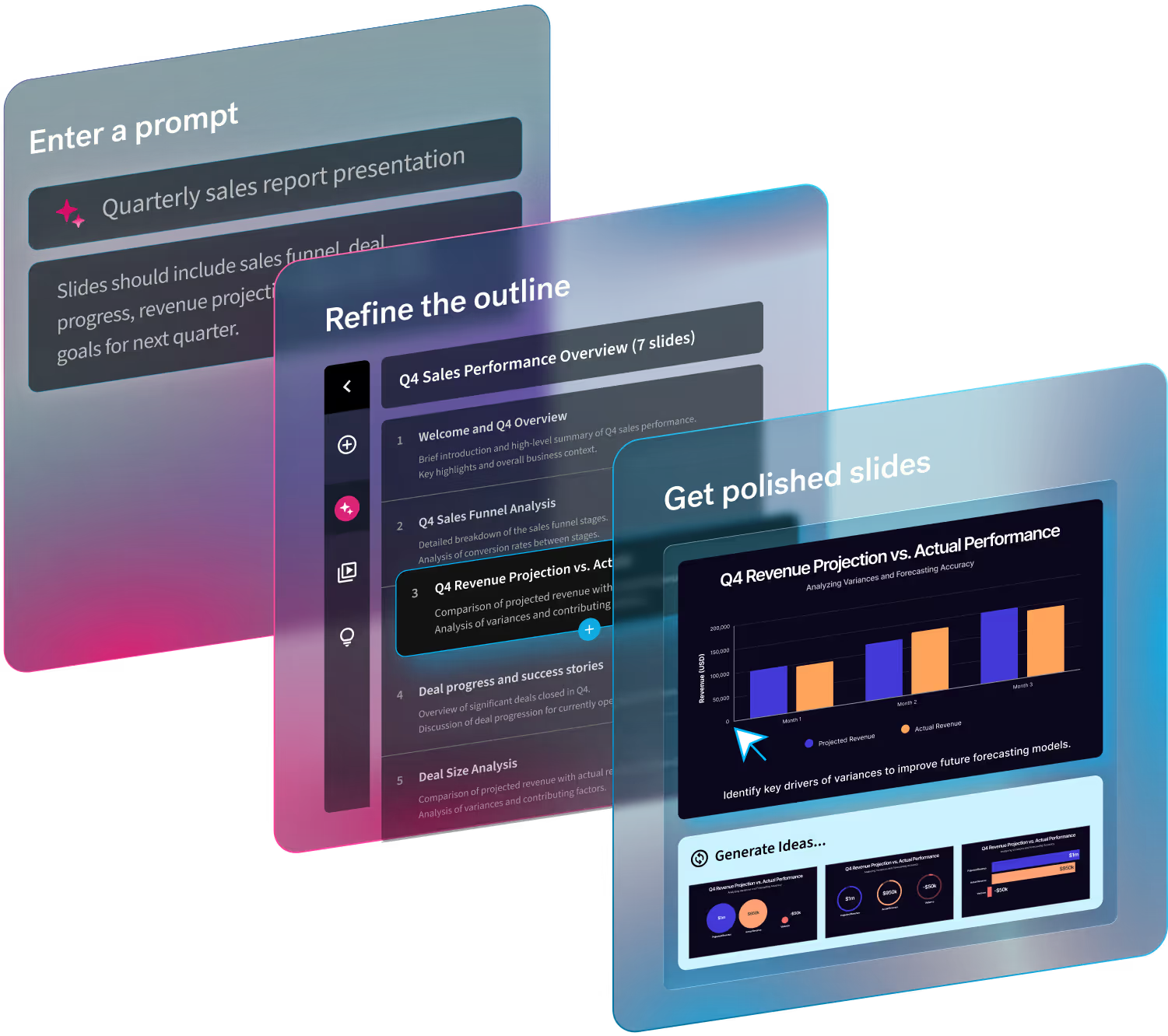
That's why organizations are increasingly looking beyond standalone AI tools and toward AI-enabled workflows. Rather than treating AI as a one-time content generator, Beautiful.ai's Create with AI Workflow helps teams move from outline to polished presentation. Structured workflows like these preserve consistency, collaboration, and brand standards.
The organizations creating lasting advantages aren't simply deploying AI. They're building systems around it.
Focus on consistent and collaborative execution
As AI becomes more common, execution becomes more important.
The companies seeing the greatest gains are using the same tools as most, but they’re using them more consistently. They have established workflows, shared standards, and clear expectations around how AI should be used. That consistency creates leverage.
When teams know how to move from idea to output quickly, productivity gains compound. When successful workflows are documented and shared, every employee benefits from what the organization has already learned.
Beautiful.ai is built with this kind of team in mind. Brand Kits and Team Slides enable organizations to create consistent outputs that stay on brand.
The alternative is fragmented adoption. Individuals develop their own processes, results vary widely, and efficiency gains become difficult to scale. This is especially true for collaborative work.
In an environment where AI is widely available, discipline often beats experimentation.
Prompt literacy is no longer optional
Not everyone gets the same value from the same AI tool. The difference often comes down to the quality of the inputs.
Prompt literacy is one of the most important AI skills because it shapes everything that follows. AI can only work with the information it's given. The more context, constraints, and direction you provide, the more useful the output becomes.
A vague prompt like "create a marketing presentation" leaves enormous room for interpretation. Whereas a prompt that includes audience, goals, industry context, key metrics, and desired outcomes produces a very different result.
Automate your internal knowledge and data
The organizations creating the most value with AI are also finding ways to incorporate proprietary knowledge and internal context into their workflows.
Much like prompts improve outputs by providing context, AI systems perform better when they have access to relevant business information. Internal documentation, customer insights, historical data, and established processes all help AI generate more useful and accurate results.
This is where differentiation begins to emerge. Competitors may have access to the same foundation models, but they don't have access to the same institutional knowledge.
Nonetheless, even the best AI output requires evaluation, editing, and critical thinking. AI can accelerate analysis, drafting, and execution, but it still depends on people to validate assumptions, identify mistakes, and make decisions.
The organizations that combine strong AI skills with strong human judgment will consistently outperform those that rely on either one alone.
Foster a supportive culture
Technology adoption rarely fails because of technology. More often, it fails because of culture.
The 2026 AI Workplace Impact Report found that adoption is moving faster than governance. While 53% of managers report using only AI tools approved by their employer, 42% say they are willing to use tools regardless of formal regulations. That’s a significant gap.
Employees are eager to use AI, but many organizations haven't established clear standards for how it should be used. Successful AI adoption requires more than purchasing software licenses. Teams need guidance, training, and opportunities to learn from one another.
Organizations that encourage responsible experimentation tend to learn faster. Employees share successful workflows, discuss mistakes openly, and improve processes over time. Equally important, people need space to ask questions.
Culture determines whether AI becomes a capability multiplier or just another underutilized tool.
Leaders are responsible for operationalizing
For most organizations, the question is no longer whether to adopt AI, but how to operationalize it. Leaders should focus on four priorities:
Invest in training
AI proficiency can't be assumed. Training creates a common foundation that helps teams work more effectively.
Standardize workflows
Successful AI usage shouldn't depend on individual experimentation alone. Document what works. Build repeatable processes. Create shared resources that allow teams to learn from one another.
Create systems for knowledge sharing
The most valuable AI workflows often emerge organically. When teams document prompts, workflows, and lessons learned, productivity gains become easier to scale across the organization.
Measure outcomes, not usage
The goal isn't to maximize prompts, tokens, or subscriptions. The goal is to improve business outcomes. Focus on productivity gains, quality improvements, speed of execution, and measurable business impact.
(Un)successful integration will be obvious
As AI becomes standard, poor execution becomes more visible.
Organizations that focus exclusively on tool adoption often encounter the same problems. Tool sprawl. Rising software costs. Inconsistent outputs. Limited productivity gains.
It's easy to be attracted to the latest AI product promising transformational results. But accumulating tools without a clear strategy rarely creates meaningful value.
AI usage is already becoming routine across organizations. As competitors continue refining workflows and building operational discipline, companies that fail to do the same risk falling behind because they failed to build systems.
It’s time to reconsider how you use AI
For a brief moment, access to AI felt like a competitive advantage. That moment is ending.
Daily AI usage continues to rise. Confidence in AI capabilities is growing. Workplace expectations are increasing as AI becomes embedded in everyday operations. AI is moving from experiment to infrastructure, and infrastructure rarely creates differentiation on its own.
The organizations that succeed won't be the ones with the largest collection of AI tools. They'll be the ones that build the strongest systems around them.
In a world where everyone has AI, execution becomes the advantage and the best operators will win.
See how Beautiful.ai can help your team turn AI into a competitive advantage.

.avif)

.avif)

.gif)
